
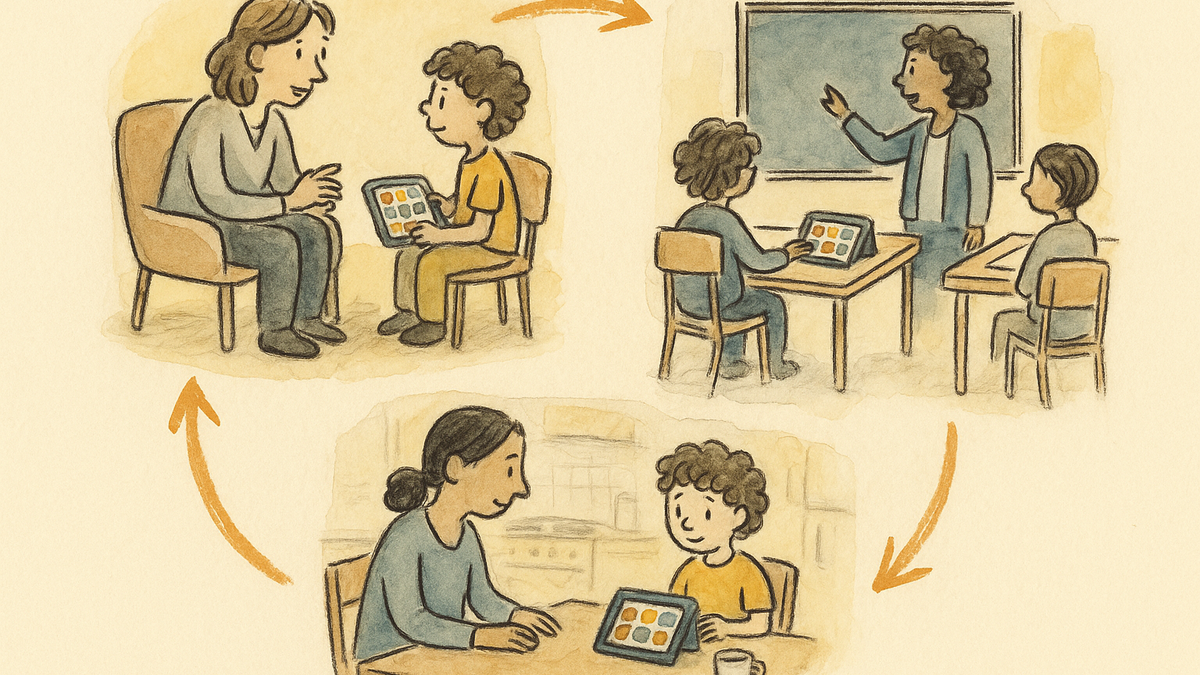
A person who uses AAC moves through many rooms in a week: the clinic, the classroom, the kitchen. Progress depends on whether the adults in those rooms are actually talking to each other.
Picture a learner who uses AAC. On Tuesday they work with an SLP on requesting with core words. On Wednesday a teacher supports them through part of the school day. Every evening they're home with family. The learner moves fluidly between these worlds, carrying the same device and the same need to be understood.
The problem is that the adults usually don't move with them.
The clinician's goals live in an IEP binder. The teacher has a rough sense of them. The caregiver, most of the time, is guessing, supporting with love and instinct but without a clear line of sight into what's being targeted or how. Everyone is working hard. Everyone is working slightly differently: different words emphasized, different prompts, different expectations. For the learner, that inconsistency is friction. For those of that have experience with kids and adults on the spectrum, you know one of the things that make everything more difficult, is inconsistency.
This is the quiet reason so much genuinely good AAC work stalls. Not a lack of effort. A lack of a shared page.
Generalization is the whole game
Here's the uncomfortable truth about skill-building in AAC: what's learned in one setting does not automatically transfer to another. A word practiced only in the therapy room has a way of staying in the therapy room. The learner who reliably requests with their SLP may not do it at dinner, not because they can't, but because dinner is a different context with different cues and different partners.
The actual goal is a voice that works everywhere. And a voice that works everywhere is built by practicing everywhere: the same vocabulary, the same prompting approach, the same expectations, across the clinic, the classroom, and the home. That kind of consistency is impossible to achieve when the people in those three places aren't coordinated. Generalization isn't a bonus that happens after the "real" work; it is the real work, and it's a team sport.
The practitioner's real job is bigger than the therapy hour
The most effective practitioners have quietly figured this out: their job isn't only to deliver an intervention. It's to equip the whole team to deliver it too.
That means coaching caregivers on the two or three habits that actually move the needle (modeling, wait time, prioritizing core vocabulary) and making sure everyone is using consistent language for prompting and progress. A goal that only the clinician truly understands is a goal that only gets worked on for thirty minutes a week. A goal the whole team understands gets worked on all week long.
None of this diminishes clinical expertise. It multiplies it. The practitioner who spends a little time turning caregivers into confident communication partners gets far more reach than the one who keeps all the work inside the session.
The caregiver is the practitioner's best source of data
The relationship runs both ways. A clinician sees a thin slice of the week; the caregiver sees the whole thing. What the learner does at home is real clinical signal: the spontaneous "more" nobody prompted, the frustration that flares at a specific moment, the breakthrough at the dinner table on a Thursday. It's often better signal than a structured session, because it's communication happening in the wild, for real reasons.
When that information flows back to the practitioner, everything sharpens. Goals get more relevant. Progress notes get truer. Decisions get grounded in how the learner actually communicates across their life, not just how they perform in a room.
A two-way conversation, not a report card
The shift worth making is from "the clinician reports to the family" to "the team communicates." One is a status update. The other is a partnership.
In a real partnership, both sides can see the same goals. Both use a common vocabulary for what a prompt is and what progress looks like. Updates travel in both directions. And underneath it all is a basic respect: the family are the experts on the person (their history, their motivations, their whole life), while the clinician is the expert on the method. Neither is complete without the other.
Closing the loop
For a long time, the thing standing in the way of all this wasn't willingness. It was infrastructure. A learner's communication happened in one place, the clinical goals and documentation lived in another, and home practice happened somewhere else entirely. Keeping everyone aligned meant a steady stream of emails, printouts, hallway conversations, and memory. It's the kind of glue work that quietly falls apart the moment anyone gets busy.
So it's worth asking: what if the loop closed on its own?
What if the learner's actual communication became the shared source of truth, quietly informing the clinical picture, so that what they really do with their voice helps shape their goals and their progress record? The practitioner reviews that picture, confirms what's accurate, and signs off. Nothing gets documented without clinical judgment in the loop. The caregiver sees those same confirmed goals and reinforces them at home. The learner practices across every setting, which feeds the picture again. The circle keeps turning, and everyone stays on the same page without anyone having to manually keep it that way.
That principle, passive proposes, clinician confirms, is exactly how EnrichPoint's practitioner and caregiver tools are designed to work together. The practitioner always holds the pen; the family stays genuinely in the loop; the learner's real communication ties it all together. The goal isn't to automate clinical judgment. It's to remove the busywork that keeps a team from acting like one.
One learner, one team
Strip away the tools and the terminology and you're left with something simple. A person who is working hard to be understood deserves the adults around them to be working together.
When the clinic and the kitchen table are finally on the same page (same words, same expectations, same goals, visible to everyone who matters), the person in the middle gets what they've deserved all along: a consistent, reliable, dignified voice, everywhere they go.
EnrichPoint builds a connected AAC ecosystem for non-speaking and minimally verbal learners, the caregivers who support them at home, and the clinical and educational teams working to give them a voice.
Get new posts in your inbox
Occasional updates from EnrichPoint, new product launches, blog posts, and tips for caregivers and families. No spam. Unsubscribe anytime.
By subscribing, you agree to receive occasional emails from EnrichPoint. Every email includes a one-click unsubscribe link.