Your Sunday night, back
The device already counted it. You say what support you gave, and the progress report drafts itself from that. You still make every clinical call.
Does this sound like your week?
Progress reports take your evenings
The data is on a clipboard, in a spreadsheet and in your head, and it gets typed up the night before it is due.
You only see what happens in your room
You see a student twice a week. Their device is with them for thirty hours, and all of that is invisible to you.
You tally while you teach
Running a session and keeping data on it at the same time means one of them gets less of you.
Parents ask the same question
“Is my child doing it on their own yet?” And the honest answer has been “sometimes, with support”.
How it works
Real screens from our demonstration district. The students are invented; nothing else is.
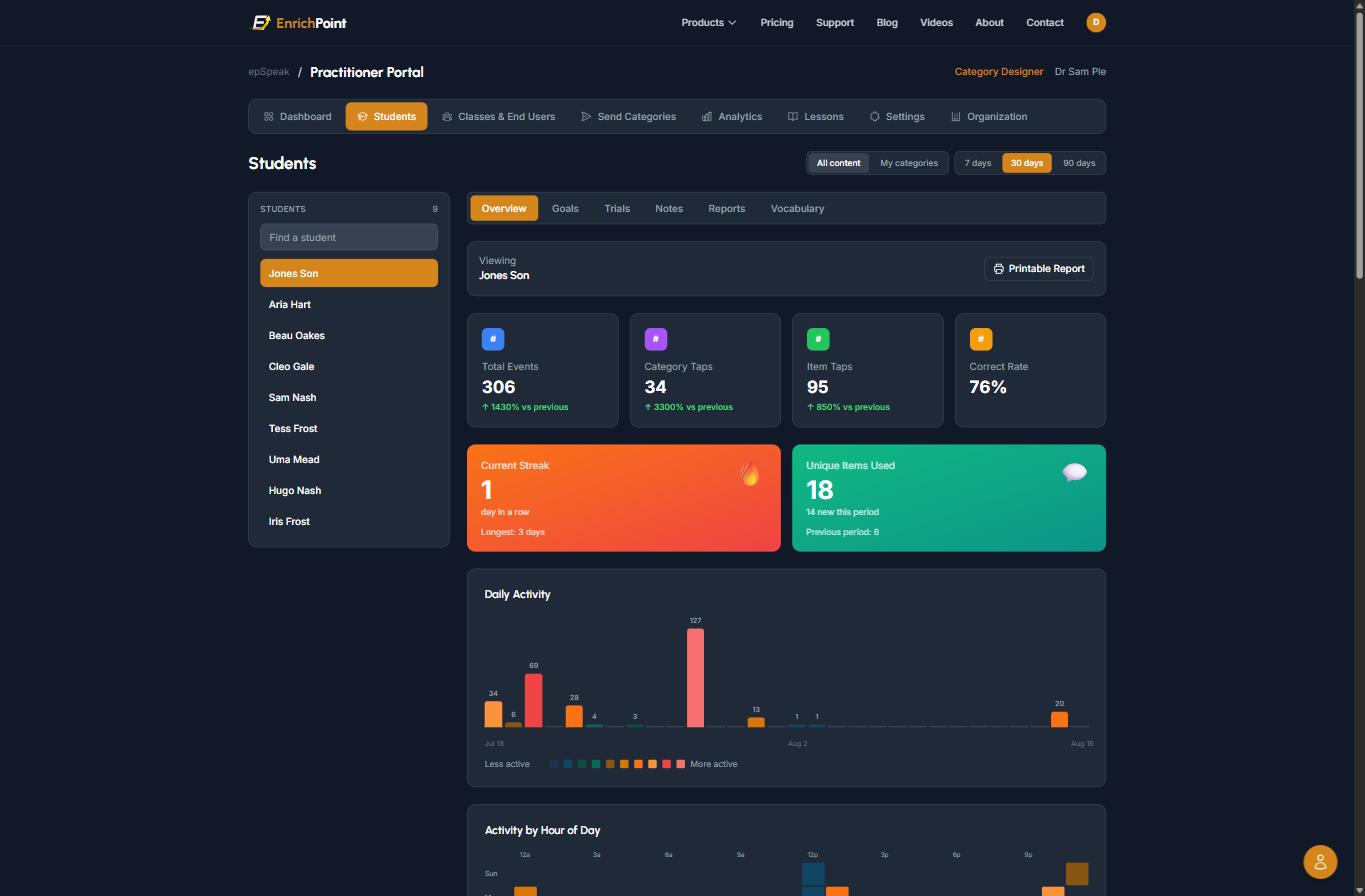
The device already counted it
When a student uses epSpeak, their own device records it: how often they communicate, when in the day, and the words they used for the first time this period. In class, at lunch and at home, not just in your sessions. Nobody types any of it up.
It proposes a trial. You say what support was given
When a student’s device use matches one of their goals, it is proposed as a trial. It does not count until you confirm it and choose the support level: independent, indirect verbal cue, verbal, gestural or model. The software cannot see whether anyone modelled or cued, so it asks. And when it gets one wrong, you mark it “not a trial” and it never becomes evidence.


Shown in the epPractitioner Android app. The same review is in the web portal.
The report drafts itself from what you confirmed
When reports are due, one click drafts one from your confirmed trials, per goal, with the support levels intact. You edit anything you disagree with, and the draft and your version are both kept. It lists anything it could not fill in rather than making it up. Nothing is documentation until you approve and sign it, and after that it locks.
Drafted
Kit requested preferred items using the device in 64% of 28 opportunities, at a gestural prompt or better.
What the clinician signed
Kit requested preferred items in 64% of 28 opportunities, up from 38% at baseline. Most requests still follow a gestural cue, so the next goal keeps the same skill and raises the bar to independent.
An illustration of the editor, not a screenshot. The real report keeps both versions the same way, so anyone can see where a number came from.
Walk into the annual review with evidence
One printable evidence pack per student: every goal with its baseline, current level and target, the trials behind it by support level, the device record, and the words used for the first time this period. Including any goal that does not yet have enough data to defend, so you find out in March rather than in the meeting.

What stays yours
Nothing counts until you confirm it
The device proposes. You confirm. Every trial in a report is one a clinician put there, with the support level they saw.
You write the goals
Condition, criterion, baseline, and which words on the device count toward it. The data can suggest the next goal. You decide it.
The family sees what you share
Families approve every connection before you see anything. You choose, note by note, what the family sees, and a signed report reaches them only if you tick the box.
The child never pays
epSpeak is free for the person using it, permanently. That is policy, not a promotion. Nothing on a child’s device changes because of a billing event.
What it does not do yet
Better you hear it here than halfway through a term.
- Trials are proposed from epSpeak use. For students on another AAC system you log trials by hand, and goals, reports and the evidence pack work the same way.
- It drafts progress reports. It does not draft session notes yet.
- It is not Medicaid billing. Where your district has service delivery switched on you can log minutes against what each IEP promises, but there are no billing codes or claim exports.
- The epPractitioner phone app is on Android now, and the iPhone version is coming soon. Everything on this page works in the web portal, in any browser.
Questions
Is AI writing my progress reports?
No. Reports are assembled from the trials you confirmed, and you edit and sign them. AI is used elsewhere: to draw pictures for a new vocabulary category, or to draft a set of lesson activities from a goal you type. You review both before anything reaches a student.
I don’t trust automatic data.
Good. Neither do we. That is why nothing counts until you confirm it and say what support was given, and why “not a trial” is right next to “confirm”.
What is in the free week?
Seven days with sample students already loaded, with real-looking history, plus a demonstration student of your own for confirming trials and drafting a report. Adding your real students and sending vocabulary to their devices start when you subscribe.
What does it cost?
For a clinician buying for themselves, the Practitioner plan is $39.99 a month or $399.99 a year. Districts and clinics license seats per clinician, by quote, and never per student, so a bigger caseload does not cost more.
My district would pay for this. What do I do?
Send your director this page, or book a demo and bring them. Districts buy on a quote and purchase order with terms on their fiscal year, and you do not have to buy it yourself first.
Can my SLPA use it?
Yes. An SLPA can hold a seat, log trials and confirm them. Formal supervision sign-off is not built yet.
What about student privacy?
Families approve every connection before a clinician sees anything. Districts can keep a log of who opened each student’s record, including our own support staff, and get a data processing agreement and the rest of the paperwork their privacy review needs.
Try it on the sample caseload
Seven days, sample students already loaded, and a demo student of your own. If it does not give you time back, you will know by Friday.