See the risk in March, not in the hearing
Special education problems usually arrive late and expensive. This shows them while there is still time, at a cost that does not rise with need.
Where special education risk comes from
You hear about it last
The first sign is a late report, an upset parent or a lawyer’s letter. By then it costs money, staff time, and sometimes the clinician.
Services are promised, not proven
Every IEP is a legal promise of minutes. Few districts can show, week by week, that those minutes happened.
Clinicians are hard to keep
SLP vacancies and contract cover are expensive, and paperwork is one of the reasons clinicians leave.
Costs rise with need
Tools priced per student or per device cost more every time another child needs help.
What your director would see
Real screens from our demonstration district. The students are invented; nothing else is.
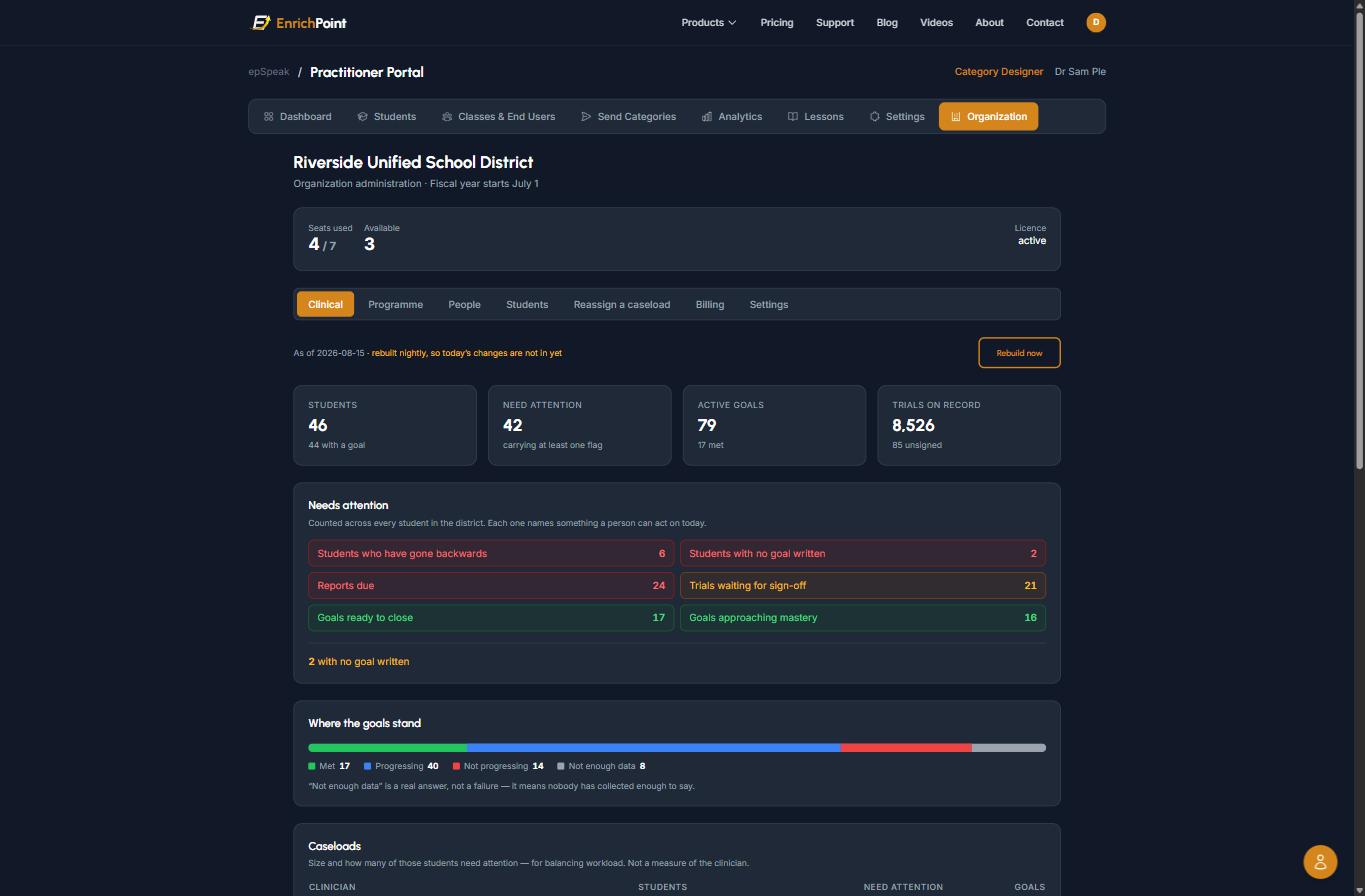
Every caseload, as a work list
One screen across every clinician: students who have gone backwards, reports due, trials waiting for sign-off, devices not being used, and goals without enough data to defend. That last one is where the district is exposed, found while it can still be fixed.
Minutes promised against minutes delivered
Where the district switches on service delivery, clinicians log sessions, including whole groups at once, and the district sees committed minutes against delivered minutes for every student, by school. It is measured in whole weeks against your own school calendar, so a week the school was closed is not counted as missed therapy.
When a clinician leaves mid-year
Their whole caseload, with its history, lessons and notes, moves to the clinician covering it in one step, with a preview first. No re-invitations and no families approving access again from scratch.
Why it holds up
A clinician confirms every piece of evidence
The student’s device proposes; a clinician confirms. Nothing becomes documentation without professional judgement.
It shows its own weak spots
Goals without enough data are named, not hidden. A record that only ever shows progress is one a hearing officer discounts.
Workload, not performance
Caseloads are shown to be balanced, never ranked. Clinicians use a tool they trust.
Cost does not rise with need
The student’s app is free, permanently. The district licenses clinicians, never students, so serving more children costs no more.
What it does not do yet
Better you hear it here than halfway through a term.
- It is not Medicaid billing. Service minutes are logged and compared with what each IEP promises, but there are no billing codes or claim exports.
- It does not replace your IEP system. It produces the evidence that goes into it.
- Rosters come in by CSV or a OneRoster file. There is no automatic Clever or ClassLink sync yet.
- The service delivery view is an early warning, not an audit filing.
Questions
How is it priced?
Per clinician seat, per year, by quote, and never per student. Terms run to your fiscal year, and seats added mid-year are prorated.
Is AI making clinical decisions?
No. Evidence is confirmed by a clinician, and progress reports are assembled from that confirmed data, then edited and signed by the clinician. AI-generated summaries of student data stay off until the district turns them on.
What about student data privacy?
Families approve every connection before a clinician sees anything. The district can keep a log of every access to a student’s record, including ours, and we provide a data processing agreement and the documents your privacy review needs.
How would we try it without a purchase?
Any clinician can start a free week on a demonstration caseload, with no purchase order and nothing to sign. Most districts start with one or two SLPs and decide from what they report back.
Thirty minutes, with your director in the room
We start with how things work in your district today, and show only what answers it. If it is not a fit, we will say so.