What happens between sessions
See whether a request generalizes outside the clinic, with every data point carrying a prompt level a person confirmed.
Does this sound familiar?
80% in the clinic. At home?
With the RBT, the learner requests at 80% with a gestural prompt. At home, at school and with grandma, you rely on what people remember.
Parent training is hard to evidence
You teach a strategy, and there is no trace of whether it happened or worked.
Three teams, one child
The clinic, the school and the SLP each hold their own data about the same learner.
How it works
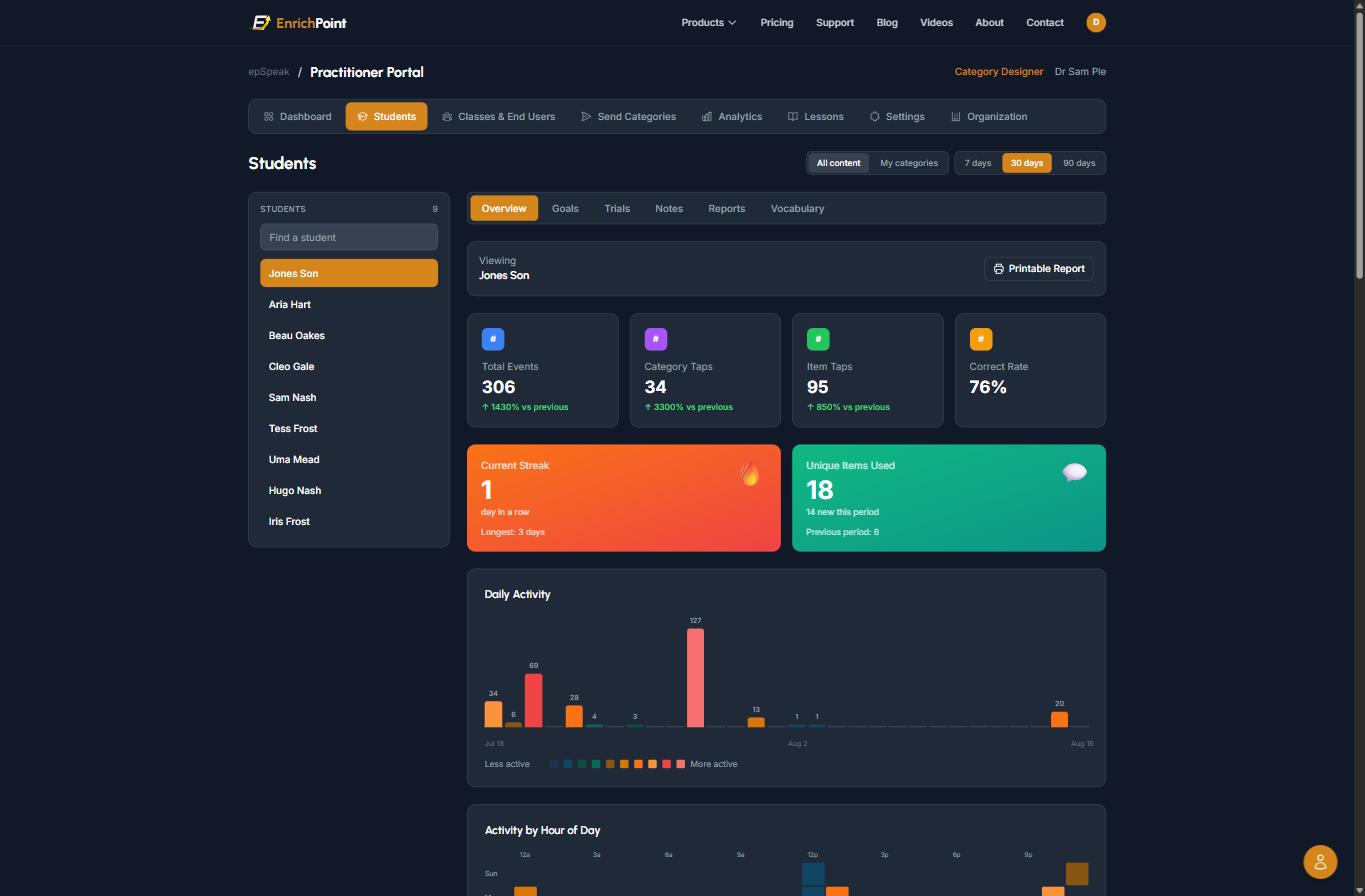
Real screens from our demonstration district. The students are invented; nothing else is.
The device record, between your sessions
A learner’s own device records their communication in every setting it goes to: days, times, what they requested and when. Weekends and evenings at home included. That is your generalization question, answered with data rather than recall.
No data point without a prompt level
When the learner’s device use matches a goal, it is proposed as a trial, and it does not count until someone who was there confirms it and chooses the support level. Exploration is marked “not a trial” and discarded. In session, you log trials directly, with an optional communicative function such as requesting or protesting.

Shown in the epPractitioner Android app. The same review is in the web portal.
Your criterion, your baseline
Goals carry a condition, a criterion measured across the sessions you set, a baseline, and the words on the device that count toward them. The default is 80% across three consecutive sessions at gestural or better, and you change it. Trials export one by one, with prompt level and function, for your own graphs or a reauthorization.
Parent training that leaves a trace
Share a note with the family about one strategy for this week. They read it in their free app and reply. Next week, the device record for evenings at home tells you whether it is working.
The words your program needs, now
If a functional communication program needs “break”, “help” and “all done” on the device, build them yourself, review every tile, and send them. The family approves the install.
What stays yours
The software refuses to guess
It cannot see prompting, so it asks. Every counted trial carries a prompt level a person chose.
Support, not surveillance
The device record is a summary for a clinician, not a transcript, and the family approves the connection first.
The learner never pays
epSpeak is free for the person using it, permanently.
Be clear about the fit
Better you hear it here than halfway through a term.
- It is not practice management. There is no scheduling, insurance billing, RBT session notes, supervision or IOA tracking. Keep your platform for those.
- There are five support levels (independent, indirect verbal cue, verbal, gestural, model). You can rename them, but there are no physical prompt levels.
- Communicative function is recorded on trials you log by hand and included in exports. It is not charted yet.
- Automatic proposals come from epSpeak. Learners on other AAC systems can have trials logged by hand.
Questions
We already collect data in our own platform.
Keep doing that for sessions. This covers what happens on the device between sessions, which your session platform does not see, and exports it for your records.
Can RBTs use it?
An RBT can hold a seat and confirm trials. Supervision workflows and supervisor sign-off are not built.
The button says IEP goal. We write treatment plan goals.
The fields are what a treatment plan goal needs: condition, criterion, baseline and measurement. The label is written for schools.
What does it cost?
The Practitioner plan is $39.99 a month or $399.99 a year for one clinician. A clinic team is licensed per clinician, by quote, never per learner.
Try it on the sample caseload
Think of one learner whose generalization data you want, and confirm a few trials on the sample students with them in mind.